Artificial Intelligence (AI) and Machine Learning (ML) are becoming important technologies in education, healthcare, banking, business, marketing and many other industries. From chatbots and voice assistants to recommendation systems and data analysis, these technologies are changing how people work and solve problems.
Thank you for reading this post, don't forget to subscribe!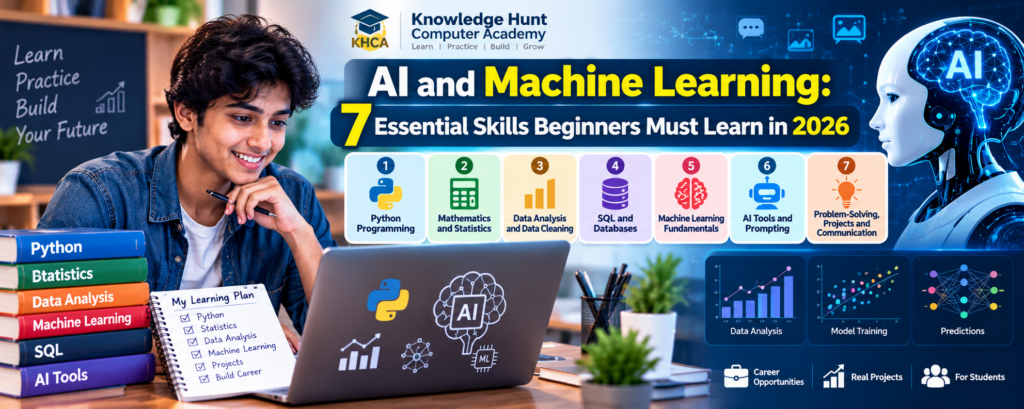
Many students want to learn AI and Machine Learning, but they are often confused about where to start. Should they learn Python first? Is mathematics compulsory? Do they need a computer science degree? Which projects should beginners build?
The good news is that students can start learning the fundamentals step by step. You do not need to master every technology at once. A clear learning plan, regular practice and small projects can help you build a strong foundation.
In this guide, we will explain seven essential skills beginners should learn to get started with AI and Machine Learning in 2026. We will also explore useful tools, practical projects, learning resources and career opportunities.
Table of Contents
What Is Artificial Intelligence?
Artificial Intelligence, commonly called AI, is a field of technology that focuses on building computer systems that can perform tasks normally associated with human intelligence.
These tasks may include understanding language, recognising images, identifying patterns, generating content, making predictions and helping people solve problems.
For example, an AI chatbot can answer questions in natural language. An image recognition system can identify objects in photographs. An AI-powered translation tool can convert text from one language into another.
Real-Life Examples of AI
AI is already used in many everyday applications.
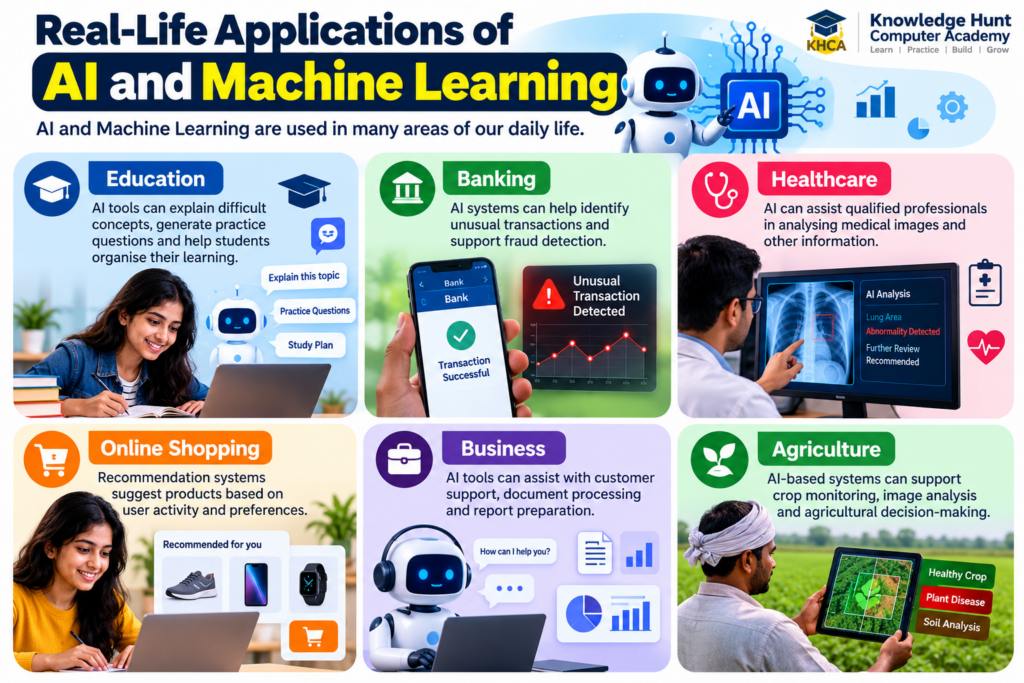
- Education: AI tools can explain difficult concepts, generate practice questions and help students organise their learning.
- Banking: AI systems can help identify unusual transactions and support fraud detection.
- Healthcare: AI can assist qualified professionals in analysing medical images and other information.
- Online shopping: Recommendation systems suggest products based on user activity and preferences.
- Business: AI tools can assist with customer support, document processing and report preparation.
- Agriculture: AI-based systems can support crop monitoring, image analysis and agricultural decision-making.
AI does not automatically provide correct answers. Its output can contain errors, bias or outdated information. Important decisions should always involve suitable human review.
What Is Machine Learning?
Machine Learning is a branch of Artificial Intelligence that allows computer systems to learn patterns from data and use those patterns to make predictions or decisions.
In traditional programming, a developer writes specific rules for a computer to follow. In Machine Learning, an algorithm uses examples to learn patterns that can be applied to new data.
For example, imagine you want to predict house prices. You collect information about previous houses, including their location, size, number of rooms and selling price. A Machine Learning model can learn relationships between these features and the prices.
After training, the model can estimate the price of another house using its available information. The estimate may not be perfect, but its quality can be measured and improved.
Common Types of Machine Learning
1. Supervised Learning
Supervised Learning uses labelled data, where the correct answer is available during training.
Examples include predicting house prices, estimating sales and classifying emails as spam or not spam.
2. Unsupervised Learning
Unsupervised Learning works with data that does not have predefined answer labels. It can help discover groups, patterns or unusual observations.
For example, a business may group customers according to their purchasing behaviour.
3. Reinforcement Learning
Reinforcement Learning trains an agent to make decisions through interaction with an environment. Feedback or rewards help it learn which actions are more useful.
It can be used in areas such as robotics, simulations and certain game-playing systems.
Beginners should first understand supervised learning, then explore the other approaches as their knowledge improves.
Difference Between AI and Machine Learning
AI and Machine Learning are closely related, but they do not mean exactly the same thing.
| Artificial Intelligence | Machine Learning |
|---|---|
| A broad field focused on intelligent computer behaviour | A branch of AI focused on learning patterns from data |
| Includes rule-based systems, planning, language technologies and learning methods | Uses algorithms to learn from examples and data |
| Can use different approaches to solve problems | Commonly uses data to train predictive or classification models |
| Example: a rule-based expert system | Example: a model predicting customer demand |
Deep Learning is another related concept. It is a type of Machine Learning that uses neural networks with multiple layers. It is important in many modern image, audio and language applications.
Understanding these relationships makes it easier to choose what to study first.
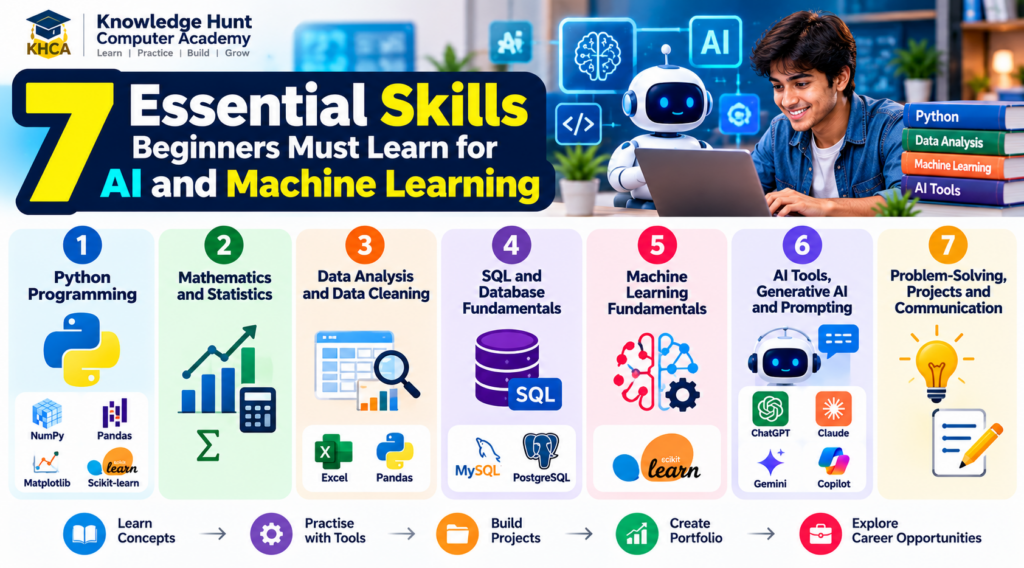
7 Essential Skills Beginners Must Learn for AI and Machine Learning
You do not need to learn everything in one week. Start with the fundamentals and gradually build your practical knowledge.
1. Python Programming
Python is one of the most widely used programming languages for AI, Machine Learning and data analysis. Its readable syntax and extensive libraries make it a useful choice for beginners.
Before building Machine Learning models, learn how to write basic Python programs and work with data.
Important Python topics to learn:
- Variables and data types
- Lists, tuples, dictionaries and sets
- Conditions and loops
- Functions and modules
- File handling
- Error handling
- Basic object-oriented programming
- Working with libraries
After learning the basics, explore these libraries:
NumPy: Useful for numerical calculations and working with arrays.
Pandas: Helps organise, clean, filter and analyse tabular data.
Matplotlib: Helps create charts and graphs for understanding data.
Scikit-learn: Provides tools for building and evaluating many traditional Machine Learning models.
For example, you could use Python to calculate monthly sales totals, identify the best-performing product and display the results in a chart.
How to practise: Write small programs every day. Create a calculator, analyse marks from a sample dataset and prepare a monthly expense report using Python.
Do not simply copy code from tutorials. Try to understand what each line does and modify the program yourself.
2. Mathematics and Statistics
Mathematics and statistics help you understand how Machine Learning models work and how to evaluate their results.
You do not need to become a mathematics expert before starting. However, a basic understanding of important concepts will make advanced topics easier.
Start with these topics:
- Mean, median and mode
- Percentages and ratios
- Variance and standard deviation
- Probability
- Correlation
- Basic algebra
- Graphs and functions
- Introductory vectors and matrices
Statistics is particularly useful when working with real-world data.
For example, suppose a shop records its daily sales for one month. You can calculate average sales, identify the highest-selling day and compare sales across different weeks.
You can also investigate whether two variables move together. However, correlation does not automatically prove that one variable causes the other.
Later, learn the basic ideas behind linear regression, probability distributions, vectors and matrix operations.
How to practise: Use Excel or Python to calculate averages, percentages, standard deviation and correlation from a small dataset. Write a few sentences explaining what the results mean.
This combination of calculations and interpretation is more useful than memorising formulas alone.
3. Data Analysis and Data Cleaning
Machine Learning depends heavily on data. If the data is incomplete, inconsistent or incorrect, the model may produce unreliable results.
Data analysis helps you understand what the data contains. Data cleaning helps you identify and correct problems before building a model.
Important skills include:
- Reading CSV and Excel files
- Understanding rows, columns and data types
- Identifying missing values
- Removing duplicate records
- Correcting inconsistent formats
- Detecting unusual values
- Filtering and sorting data
- Creating charts and summaries
- Understanding relationships between variables
For example, a student analysing sales data may find that some dates are missing, product names are written differently or a sales amount has been entered incorrectly.
These issues should be investigated before the data is used for analysis or model training.
Learn Excel for spreadsheet-based analysis and Pandas for more flexible data processing. SQL is also valuable when information is stored in databases.
How to practise: Download a suitable public dataset, identify at least five data-quality issues and prepare a cleaned version. Then create three charts and explain the main findings.
Always check whether an unusual value is genuinely incorrect before deleting or changing it.
4. SQL and Database Fundamentals
AI and Machine Learning projects often require information stored in databases. SQL helps you retrieve, filter and summarise that information.
Learning SQL is useful even if you plan to work mainly with Python.
Important SQL topics include:
- SELECT and WHERE
- ORDER BY
- GROUP BY and aggregate functions
- INNER JOIN and LEFT JOIN
- CASE WHEN
- Subqueries
- Common Table Expressions
- Basic database design
Imagine a company has separate tables for customers, orders and products. SQL can help you calculate monthly revenue, identify popular products and compare customer activity.
Python can then be used to analyse the extracted data and prepare it for a Machine Learning model.
How to practise: Create a small database containing customers, products and sales. Write queries to calculate total sales, average order value and product-wise revenue.
You can start with MySQL, PostgreSQL or SQLite. Choose one database and learn its fundamentals before moving to another.
5. Machine Learning Fundamentals
After developing basic programming, statistics and data skills, begin studying Machine Learning concepts.
A Machine Learning model learns patterns from training data. It is then evaluated to understand how well it performs on data it has not used for training.
Start with these concepts:
- Features and target variables
- Training and testing datasets
- Regression
- Classification
- Clustering
- Model evaluation
- Overfitting and underfitting
- Feature selection
- Data leakage
- Model improvement
For example, a regression model may estimate monthly sales. A classification model may predict whether a transaction resembles a previously identified fraudulent transaction. A clustering algorithm may group customers with similar purchasing patterns.
These are examples of possible uses, not guarantees that a model will make accurate predictions.
Learn how to measure performance using suitable metrics. For a classification task, you might use precision, recall and a confusion matrix. For a regression task, you might use mean absolute error or root mean squared error.
Also understand overfitting. A model may perform well on training data but poorly on new data because it has learned patterns that do not generalise.
How to practise: Build a simple regression model or classification model using Scikit-learn. Split the dataset appropriately, train the model, evaluate its performance and explain its limitations.
6. AI Tools, Generative AI and Prompting
Modern AI tools can assist with learning, programming, writing, research and data analysis. Knowing how to use them responsibly is becoming an important practical skill.
Generative AI systems can produce text, images, code and other content in response to instructions. However, they may generate incorrect information or code that contains errors.
Learn how to write clear instructions, check the results and improve the output through follow-up questions.
Useful skills include:
- Writing clear prompts
- Providing relevant context
- Breaking complex tasks into smaller steps
- Checking factual claims
- Reviewing AI-generated code
- Protecting confidential information
- Recognising bias and limitations
- Understanding when human review is necessary
For example, you could ask an AI assistant to explain a Python error, suggest test cases or describe a statistics concept in simple language. You should still run the code, verify the answer and understand the solution.
Explore AI tools such as ChatGPT and other available assistants for learning and experimentation. Their features, costs and data-handling terms may differ.
After understanding the basics, explore how AI applications use APIs, how language models work at a high level and how retrieval-based systems can use approved documents to answer questions.
You do not need to train a large language model from scratch to begin building useful AI applications.
7. Problem-Solving, Projects and Communication
Technical knowledge becomes more valuable when you can use it to solve a real problem and explain your results clearly.
Employers and clients may want to know not only which tools you have learned but also how you applied them.
Develop these skills:
- Breaking a large problem into smaller tasks
- Choosing suitable data and methods
- Testing different approaches
- Debugging errors
- Documenting your work
- Explaining results using charts and examples
- Writing clear project summaries
- Working with feedback
- Presenting limitations honestly
For example, instead of writing only “I know Python and Machine Learning” on your resume, you could explain that you built a sales forecasting project using historical sales data, compared model performance and documented the factors affecting prediction accuracy.
Build a small portfolio containing two or three well-documented projects. Upload suitable code to GitHub and include a README explaining the problem, dataset, tools, method, results and limitations.
Never present a tutorial copied without meaningful changes as an original project. Give credit to the sources you use.
Best Tools for AI and Machine Learning Beginners
You do not need to install every tool at the beginning. Start with a few essential tools and expand your setup as your projects become more advanced.
| Tool | Main use |
|---|---|
| Python | Programming and data processing |
| Jupyter Notebook | Writing and testing code interactively |
| Google Colab | Running Python notebooks in a browser |
| NumPy | Numerical computing |
| Pandas | Data cleaning and analysis |
| Matplotlib | Data visualisation |
| Scikit-learn | Traditional Machine Learning |
| SQL | Retrieving and analysing database information |
| Git and GitHub | Version control and project portfolios |
| Power BI | Business reporting and dashboards |
Official resources for learning these tools include:
- Python: https://www.python.org/about/gettingstarted/
- Pandas: https://pandas.pydata.org/docs/getting_started/
- Scikit-learn: https://scikit-learn.org/stable/getting_started.html
- Google Colab: https://colab.research.google.com/
- PostgreSQL: https://www.postgresql.org/docs/
- GitHub Skills: https://skills.github.com/
Read the documentation as you learn. You do not need to memorise everything; learn how to find reliable information and apply it to your work.
Beginner-Friendly AI and Machine Learning Projects
Projects help you connect theory with practical experience. Start with small datasets and gradually move towards more challenging problems.
Project 1: Student Marks Analysis
Use a sample dataset containing student marks in different subjects.
What you will learn:
- Reading CSV files
- Calculating averages and percentages
- Finding missing values
- Creating charts
- Summarising results using Python
This is a good first project because the data is easy to understand.
Project 2: House Price Prediction
Use a public dataset containing house prices and features such as area, location or number of rooms.
What you will learn:
- Data cleaning
- Selecting useful features
- Training a regression model
- Evaluating prediction errors
- Understanding model limitations
The model should be treated as a learning exercise, not as a reliable property valuation service.
Project 3: Spam Message Classification
Use a suitable, labelled public dataset of spam and non-spam messages.
What you will learn:
- Text preprocessing
- Converting text into numerical features
- Training a classification model
- Evaluating precision and recall
- Reviewing incorrect predictions
Be careful with personal information when working with message datasets.
Project 4: Sales Forecasting
Use historical sales data from a fictional or public business dataset to estimate future sales.
What you will learn:
- Analysing trends over time
- Working with dates
- Creating summary reports
- Establishing a simple baseline
- Evaluating forecasts on later periods
Do not use future information when training or evaluating a forecasting model. Otherwise, the results may look better than they really are.
Project 5: AI Study Assistant
Create a basic application that helps students search approved study notes and find relevant explanations.
Start with a simple search function. Later, explore language models, document retrieval and APIs.
What you will learn:
- Python application development
- Organising documents
- Designing user-friendly interfaces
- Working with APIs, where appropriate
- Checking answers against source material
An AI study assistant should clearly communicate uncertainty and avoid presenting unverified answers as facts.
A 90-Day Learning Roadmap for AI and Machine Learning
A structured plan can help beginners avoid jumping between unrelated tutorials. The following roadmap assumes regular practice. Adjust the pace according to your existing knowledge and available time.
Days 1–30: Build the Foundation
Focus: Python, mathematics and basic data analysis.
During this period:
- Learn Python variables, conditions, loops and functions.
- Practise lists, dictionaries and file handling.
- Study averages, percentages, probability and basic statistics.
- Learn NumPy and Pandas fundamentals.
- Open CSV files and analyse sample datasets.
- Create simple charts using Matplotlib.
Target outcome: Complete one small data-analysis project and explain your findings in simple language.
Days 31–60: Learn Databases and Machine Learning
Focus: SQL, data preparation and introductory models.
During this period:
- Learn SELECT, WHERE, GROUP BY and JOIN in SQL.
- Practise cleaning missing and inconsistent data.
- Understand features, target variables and train-test splits.
- Learn the difference between regression and classification.
- Train simple models using Scikit-learn.
- Evaluate model performance using suitable metrics.
- Learn about overfitting and data leakage.
Target outcome: Complete one introductory Machine Learning project and document how you evaluated the model.
Days 61–90: Build Projects and Prepare a Portfolio
Focus: Practical applications and communication.
During this period:
- Choose a problem that interests you.
- Find an appropriate public or synthetic dataset.
- Clean and analyse the data.
- Build and evaluate a suitable model.
- Compare the model with a simple baseline.
- Document your code and results.
- Publish suitable project files on GitHub.
- Prepare a resume that accurately describes your skills.
- Practise explaining your project and its limitations.
Target outcome: Have two or three small projects, a clear understanding of your learning progress and a portfolio you can discuss in an interview.
Completing this roadmap does not make someone an expert or guarantee employment. It provides a structured starting point for further learning.
Career Opportunities in AI and Machine Learning
AI and Machine Learning knowledge can support several career directions. The right role depends on your skills, qualifications, experience and the requirements of individual employers.
1. Data Analyst
Data Analysts organise and analyse information to help businesses make decisions.
Useful skills include Excel, SQL, data visualisation, statistics and communication. Python may be required for some roles.
2. Junior Data Scientist
Data Scientists use statistics, programming and analytical methods to investigate data and build predictive models.
These roles often require stronger knowledge of mathematics, statistics, Python and Machine Learning. Many employers prefer relevant academic or project experience.
3. Machine Learning Engineer
Machine Learning Engineers develop, deploy and maintain Machine Learning systems.
In addition to ML concepts, these roles may require strong programming, software engineering, testing, APIs, cloud platforms and model monitoring.
4. AI Application Developer
AI Application Developers integrate AI capabilities into websites, mobile apps or business software.
Useful skills may include Python or another programming language, APIs, backend development, databases and responsible AI integration.
5. Business Intelligence Analyst
Business Intelligence Analysts transform business data into reports and dashboards.
Excel, SQL, Power BI, data modelling and an understanding of business requirements are particularly useful.
6. AI Researcher
AI Researchers investigate new methods, models and techniques. These roles commonly require strong mathematical foundations, programming ability and advanced study or research experience.
Important: Learning AI tools alone does not qualify someone for every AI-related job. Review job descriptions in your preferred location, identify recurring requirements and build your skills accordingly.
Common Mistakes Beginners Should Avoid
Students often lose time by trying to learn too many technologies at once. Avoid these common mistakes:
1. Starting with advanced AI models immediately
Learn programming and basic data handling first. A strong foundation makes advanced concepts easier to understand.
2. Copying code without understanding it
Write your own small examples, modify existing code and explain the output in your own words.
3. Ignoring mathematics and statistics
You do not need advanced mathematics on day one, but understanding statistics is essential for interpreting data and evaluating models.
4. Using poor-quality data
Check missing values, duplicates, incorrect formats and possible bias before drawing conclusions.
5. Trusting every AI-generated answer
Verify facts, test code and consult reliable documentation.
6. Collecting certificates without building projects
Certificates can demonstrate learning, but practical projects help show how you apply your knowledge.
7. Expecting a job in a fixed number of days
Learning speed varies. Focus on consistent practice, clear progress and relevant skills rather than unrealistic promises.
Frequently Asked Questions
1. Can beginners learn AI and Machine Learning in 2026?
Yes. Beginners can start by learning Python, basic mathematics, statistics and data analysis. They can then move to introductory Machine Learning concepts and small projects.
2. Is Python necessary for AI and Machine Learning?
Python is one of the most useful languages for learning AI and Machine Learning because of its libraries and learning resources. Some AI tools can be used without programming, but Python provides greater flexibility for data processing and model development.
3. Do I need advanced mathematics to learn Machine Learning?
You can begin with basic algebra, percentages, averages and introductory statistics. More advanced topics such as linear algebra, probability and calculus become useful as you study more complex models.
4. Can Commerce students learn AI and Machine Learning?
Yes. Commerce students can start with Excel, statistics, SQL and Python. Their understanding of accounting, finance, sales and business operations can also help them identify useful data-analysis problems.
Students interested in data analytics may find it helpful to begin with business reporting projects before progressing to Machine Learning.
5. What is the difference between AI, Machine Learning and Deep Learning?
AI is the broader field of intelligent computer systems. Machine Learning is a branch of AI that learns patterns from data. Deep Learning is a type of Machine Learning based on neural networks with multiple layers.
6. Which project should a beginner build first?
Start with a project that uses familiar data, such as student marks analysis or sales reporting. After learning basic data cleaning and visualisation, try a simple regression or classification project.
7. Can I learn AI and Machine Learning for free?
Yes. Python documentation, Scikit-learn documentation, Google Colab and many educational resources are available online without a course fee. Some platforms also offer paid certificates, advanced features or structured programmes.
Check the current terms and costs before enrolling.
8. Does learning AI and Machine Learning guarantee a job?
No. Employment depends on many factors, including practical skills, qualifications, communication, project quality, experience and employer requirements. A structured learning plan and relevant portfolio can help you prepare, but they cannot guarantee a job.
Conclusion
AI and Machine Learning are valuable areas to explore if you enjoy technology, problem-solving and working with data. However, the best way to begin is not by trying to learn every AI tool at once. Build a strong foundation and progress one skill at a time.
Start with Python programming, mathematics and statistics, data analysis, SQL, Machine Learning fundamentals, AI tools and practical problem-solving. Use these skills to complete small projects and explain what you have learned.
Set a realistic study schedule and practise consistently. Keep your projects organised, document your work and learn to check the accuracy and limitations of AI-generated results.
The most important step is to begin with a simple project and improve it as your knowledge grows. With patience, practice and continuous learning, you can develop a useful foundation for further study in AI, Machine Learning and data-related careers.
At Knowledge Hunt Computer Academy (KHCA), students can explore computer skills and technology learning opportunities that support their educational and career goals. Choose relevant training, practise what you learn and continue developing skills that match your interests.
Useful Official Resources
- Python Getting Started: https://www.python.org/about/gettingstarted/
- Pandas Documentation: https://pandas.pydata.org/docs/
- Scikit-learn Getting Started: https://scikit-learn.org/stable/getting_started.html
- Google Colab: https://colab.research.google.com/
- PostgreSQL Documentation: https://www.postgresql.org/docs/
- GitHub Skills: https://skills.github.com/