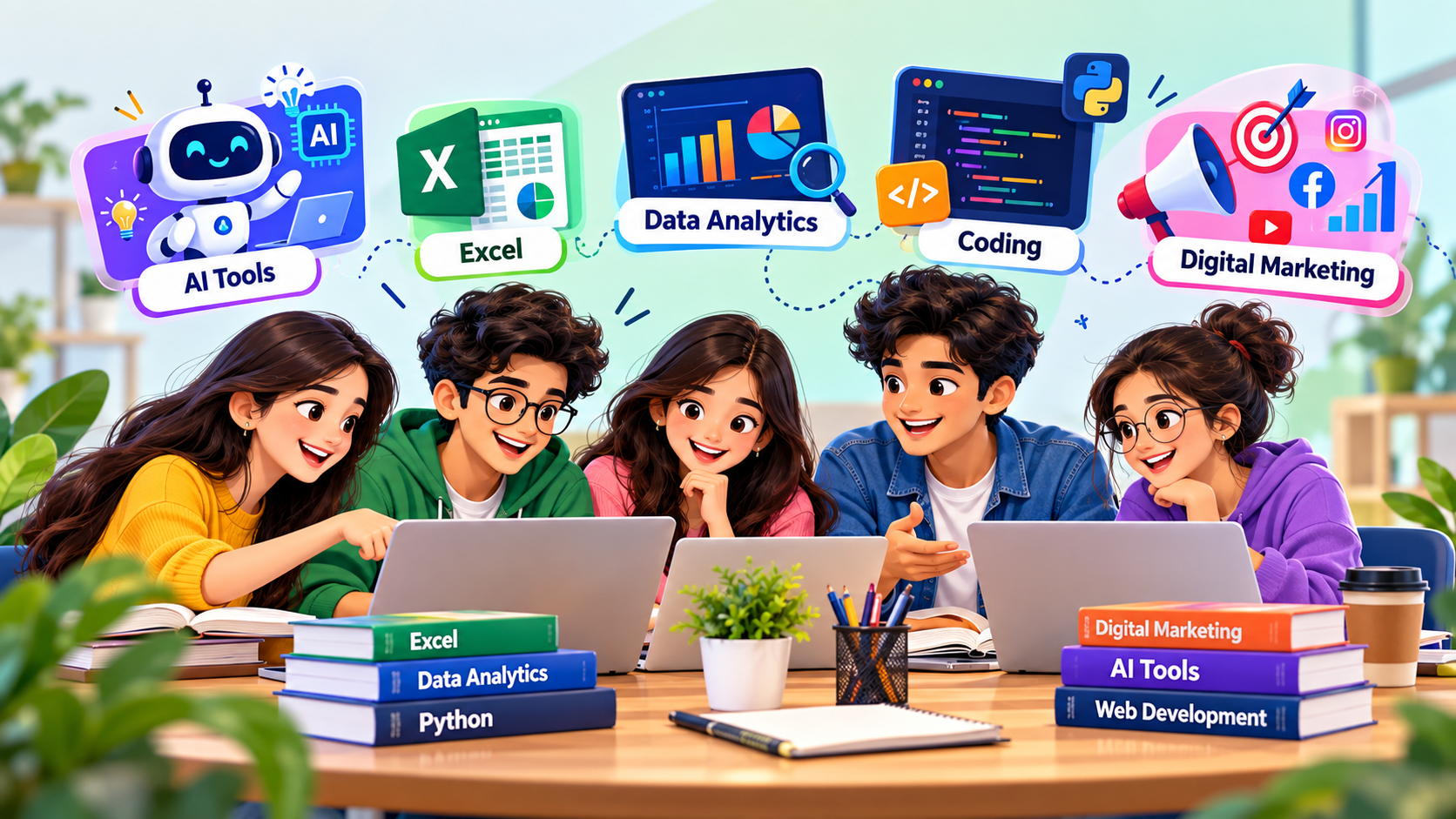
Skills to learn for jobs in 2026 are becoming increasingly important for students, freshers and working professionals. Today, many companies use Artificial Intelligence (AI), automation, cloud software and digital tools in their daily work.
Thank you for reading this post, don't forget to subscribe!A degree is valuable, but practical skills can help you apply your knowledge in real situations. Learning the right skills can help you prepare for job applications, improve your current work and explore new career options.
In this guide, you will learn about 10 important skills, how they are used in real jobs and how to choose the right skills for your career goals.
The Job Market Is Changing. Are Your Skills Changing Too?
A few years ago, having a degree and basic computer knowledge was enough to apply for many jobs. Today, many jobs also require practical knowledge of software, digital tools and modern work methods.
This is why choosing the right skills to learn for jobs in 2026 is important for students and working professionals who want to prepare for changing job requirements.
Think about two B.Com students.
The first student has completed a B.Com degree. The second student has completed the same degree and also knows Tally, GST, Advanced Excel and basic AI tools.
Both have the same degree, but their practical skills are different. The second student may be better prepared for some accounting and office roles, depending on the employer’s requirements.
This does not mean that a degree has lost its value. It means that combining education with practical skills can make your knowledge more useful.
A degree tells an employer what you have studied. Your skills help you show what you can actually do.
Why Should You Learn New Skills in 2026?
The changes in the job market are not just a social media trend. Technology is changing how businesses work and what employers expect from workers.
The World Economic Forum’s Future of Jobs Report 2025 estimates that 39% of workers’ existing core skills may change by 2030. The report also highlights AI and big data, networks and cybersecurity, and technological literacy among the fastest-growing skills.
Human skills remain important too. Analytical thinking, creativity, flexibility and a willingness to keep learning can help people adapt to changing work requirements.
In India, government skill-development initiatives also focus on areas such as Artificial Intelligence, Machine Learning, Cloud Computing, Data Analytics and Cybersecurity.
When exploring skills to learn for jobs in 2026, consider both technical abilities and human skills. Choose skills that match your education, interests and career goals.
The message is simple: technology skills matter, but human skills matter too.
Table of Contents
10 Important Skills to Learn for Jobs in 2026
You do not need to learn every trending skill on the internet. The right choice depends on your education, interests and career goals.
Here are 10 useful skill areas to consider.
1. Artificial Intelligence (AI) Skills

Artificial Intelligence is becoming part of everyday work. It can help people prepare drafts, organise information, generate ideas and work with data.
Learning AI does not always mean becoming an AI engineer. Teachers, accountants, marketers, designers, business owners and office employees can also learn to use AI tools in their work.
Start by learning:
- Basics of Generative AI
- Writing clear prompts
- AI tools for office work
- AI-assisted research
- Using AI with Excel and data
- Checking AI-generated information
- Responsible use of AI
Practical example
Suppose you prepare similar reports every week. You can use suitable AI tools to create a first draft, organise information or explain results. You must still check the information before using it.
The real skill is not simply clicking an AI button. It is knowing what to ask, checking the result and using it correctly.
2. Data Analysis

Every business creates data. Shops have sales records, schools have student records, banks have transaction data and websites have visitor information.
Data analysis helps people understand what this information means. It can help businesses compare results, identify problems and make better decisions.
A beginner learning path:
Excel → SQL → Power BI → Basic Statistics → Python
Practical example
Imagine a company has sales records for the last 12 months. A data analyst can use these records to find the best-selling products, compare monthly sales and identify branches that need improvement.
Data analysis is useful in business, finance, marketing, operations and technology-related roles.
3. Advanced Excel
Excel remains a practical tool for accounting, administration, finance, sales, human resources and business reporting.
Basic Excel helps you enter and organise data. Advanced Excel helps you work with larger datasets, find information quickly and prepare useful reports.
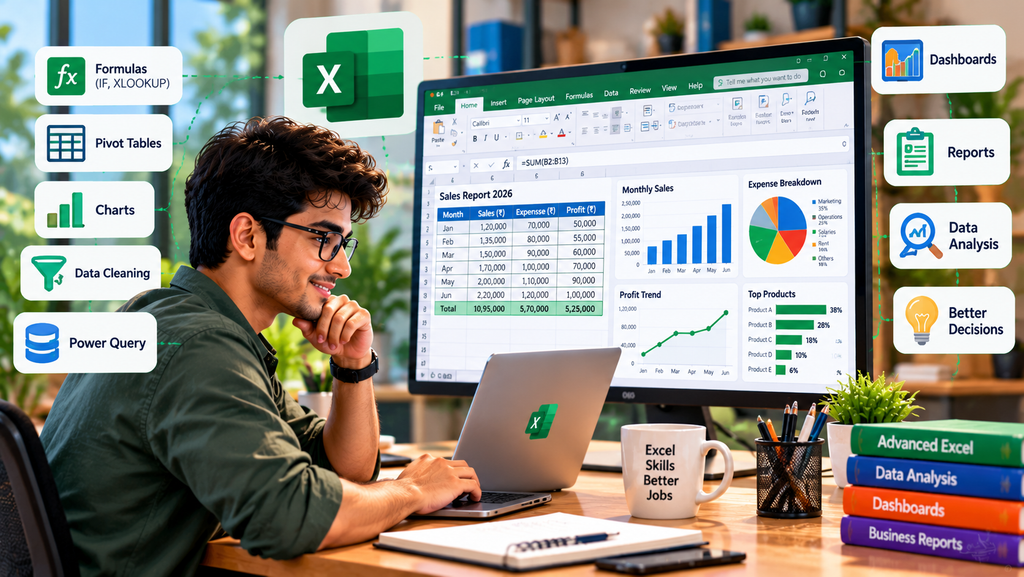
Important topics to learn:
- IF and other logical functions
- XLOOKUP
- INDEX and MATCH
- Pivot Tables
- Charts and dashboards
- Data cleaning
- Conditional Formatting
- Power Query
Practical example
Suppose you receive a sales file containing thousands of rows. You can use Excel to clean the data, calculate totals, compare products and create a sales dashboard.
Start with the functions you need most. Practise using real or sample business data instead of only watching tutorials.
4. SQL and Database Skills
A database stores information in an organised way. Businesses use databases to manage customers, products, employees, orders and transactions.
SQL stands for Structured Query Language. It helps users retrieve and work with information stored in relational databases.
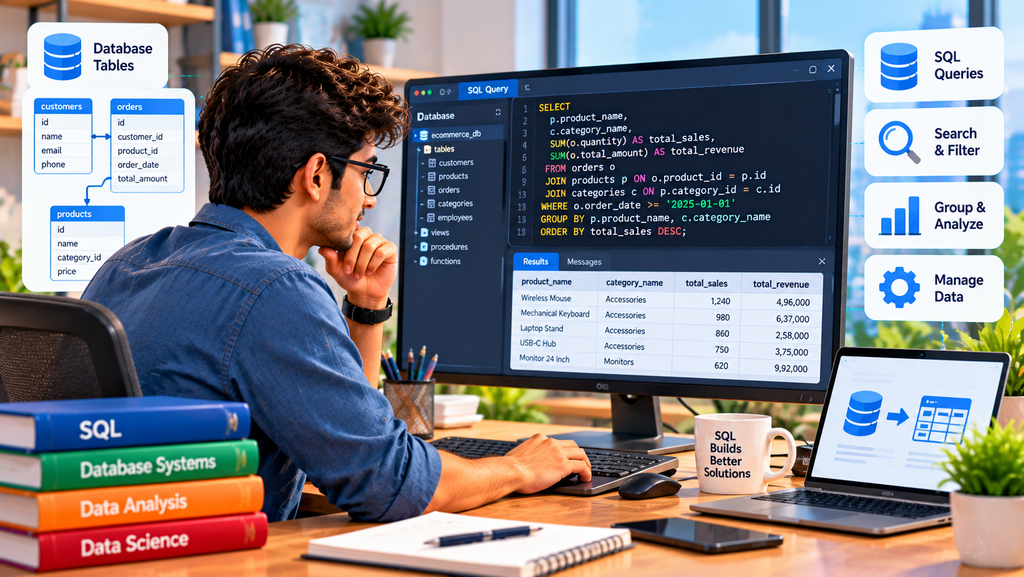
Start with these topics:
- Database basics
- SELECT
- WHERE
- ORDER BY
- GROUP BY
- JOIN
- Subqueries
- Practice projects
Practical example
A shop has thousands of sales records. Using SQL, you can find the total sales for a month, list the most popular products or retrieve orders from a particular customer.
SQL is useful for people interested in Data Analytics, Business Intelligence, database work and software development.
5. Cybersecurity Awareness
As more work happens online, protecting information and digital accounts becomes increasingly important.
Even if you do not want a cybersecurity career, basic security knowledge can help you avoid common online risks.

Start by learning:
- Strong passwords
- Password managers
- Two-factor authentication
- Phishing emails and fake links
- Data privacy
- Safe downloads
- Online fraud awareness
- Basic network security
If you want to build a career in cybersecurity, you can later study networking, Linux and security fundamentals. Practise security testing only on systems you own or have permission to test.
6. Digital Marketing
Digital marketing helps businesses reach customers through online channels such as search engines, websites, social media and email.
It is useful for companies, local businesses, educational institutions and people who want to promote their own services.
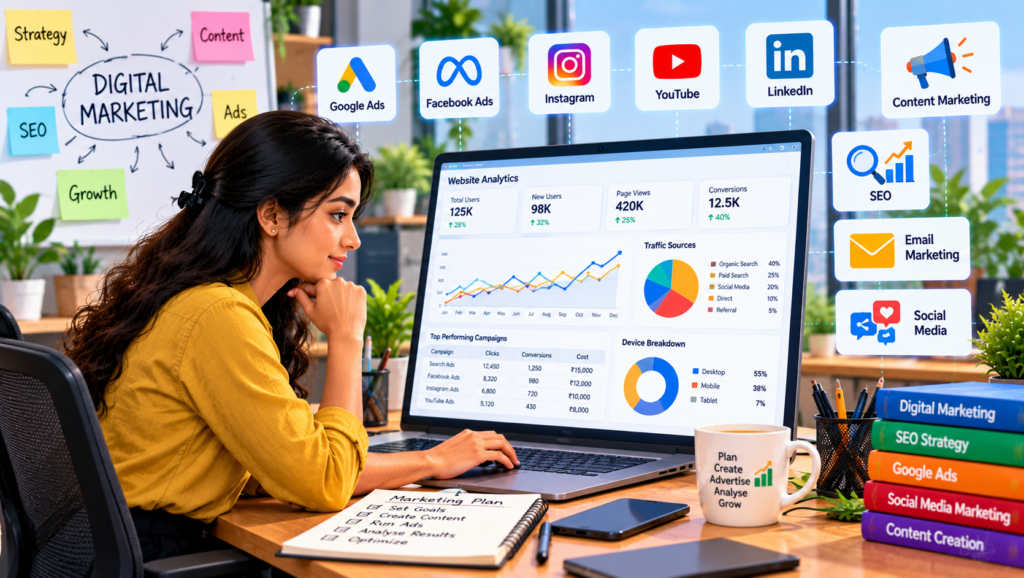
Important areas include:
- Search Engine Optimisation (SEO)
- Social Media Marketing
- Content Marketing
- Google Ads
- Social Media Advertising
- Email Marketing
- Website Analytics
- AI-assisted marketing
Practical example
Imagine a computer training institute wants more students to enquire about its courses. A digital marketer can improve website content, create useful social media posts, run suitable advertising campaigns and measure enquiries.
Digital marketing is not simply posting on Instagram. You need to understand the audience, choose the right channel and check whether your work is achieving its goal.
7. Programming and Automation
Programming helps you give instructions to a computer to perform specific tasks. It also teaches logical thinking and problem-solving.
You do not need to learn several programming languages at once. Choose one language based on your goal.
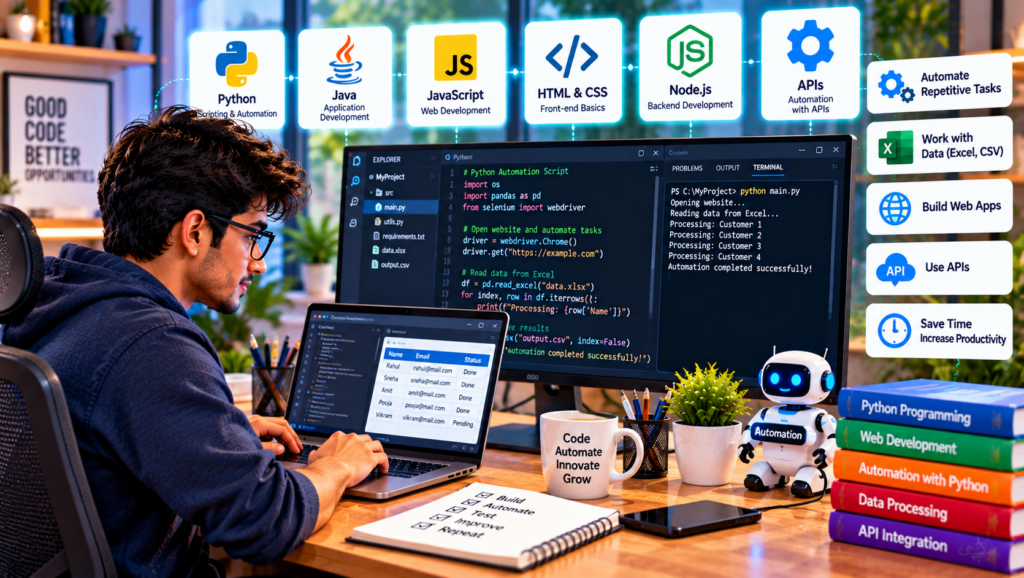
Popular starting options:
- Python: Useful for automation, data analysis, AI and software development.
- Java: Used in enterprise applications and many software systems.
- JavaScript: Important for interactive websites and web applications.
Practical example
You may write a small program to organise files, calculate expenses or process a set of records. These projects help you understand how programming solves practical problems.
Learn the basics, practise regularly and build small projects before moving to advanced topics.
8. Communication Skills

Technical knowledge is important, but you also need to explain your work clearly.
Communication skills are useful in interviews, meetings, presentations, customer service and teamwork.
Good communication does not mean using difficult English words. It means listening carefully, understanding the situation and explaining your ideas in a clear way.
Simple ways to improve communication:
- Speak in English for five minutes every day.
- Read short English articles.
- Learn commonly used workplace words.
- Write short professional emails.
- Practise introducing yourself.
- Explain a topic in your own words.
You do not need perfect English to start. Regular practice can help you become clearer and more confident.
9. Analytical Thinking and Problem-Solving
Analytical thinking means understanding a problem before trying to solve it.
Imagine a company’s sales fall by 20%. One person reports that sales have decreased. Another person checks which products, locations and months are responsible for the fall.
The second person is looking for the reason behind the problem.
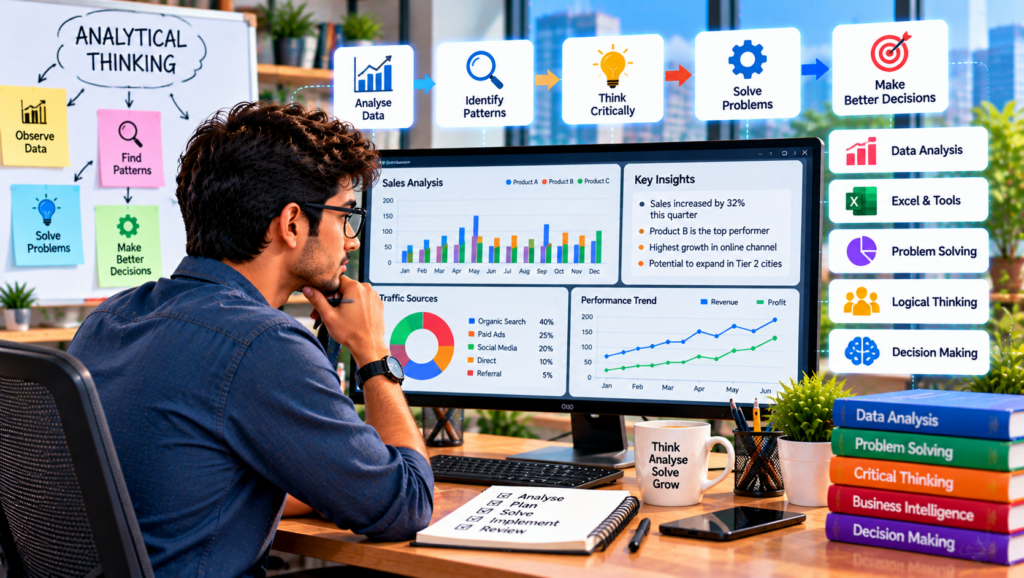
You can practise this skill by:
- Asking clear questions
- Checking facts before making decisions
- Comparing different solutions
- Learning from mistakes
- Working on practical projects
- Explaining why you chose a solution
This skill is useful in almost every career because many jobs involve understanding problems and deciding what to do next.
10. Adaptability and Continuous Learning
Technology, software and job requirements change over time. A skill that is useful today may need to be updated in the future.
Adaptability means being ready to learn new things and change your approach when needed.
You do not have to know everything. You need to build the habit of learning throughout your career.
Try following this simple cycle:
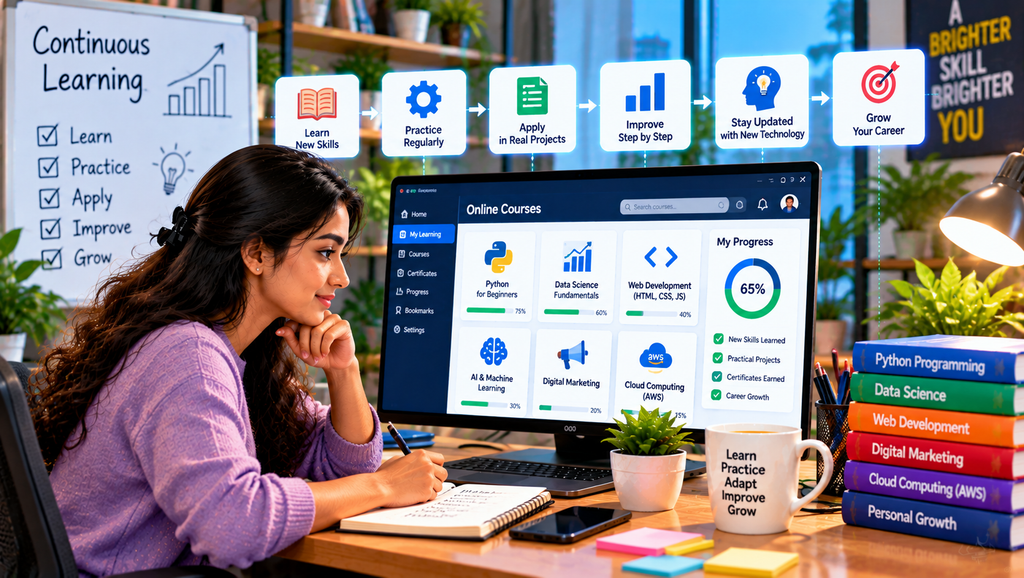
Learn → Practise → Build → Get Feedback → Improve
For example, after learning Excel, create a sales report. Ask someone to review it, correct your mistakes and improve the report.
Small improvements made regularly can help you build stronger skills over time.
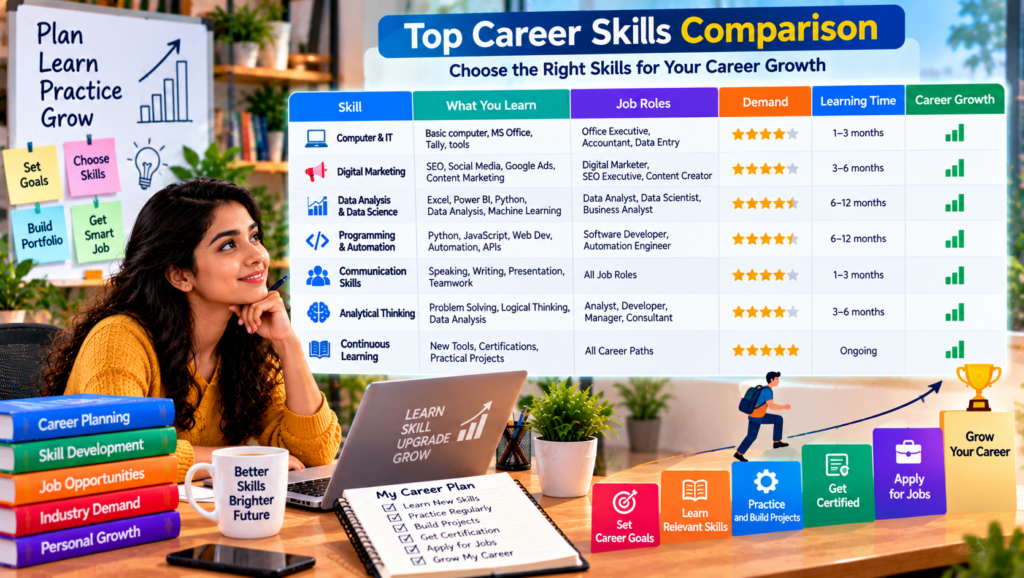
Which Skills Should You Learn for Your Career?
The best skills depend on the type of work you want to do. Use this table as a starting point.
| Career goal | Skills to start with |
|---|---|
| Office and Administration | MS Office, Advanced Excel, AI tools, Communication |
| Accounting and Finance | Tally, GST, Advanced Excel, AI tools |
| Data Analyst | Excel, SQL, Power BI, Statistics |
| Data Science | Python, SQL, Statistics, Machine Learning |
| Digital Marketing | SEO, Content, Social Media, Analytics |
| Graphic Design | Design basics, Canva, Photoshop, Illustrator |
| Cybersecurity | Computer basics, Networking, Linux, Security fundamentals |
| Software Development | Programming, Databases, Git, Projects |
| Business and Management | Excel, Data Analysis, Communication, Digital Marketing |
These are suggested learning combinations, not guaranteed job formulas. Employers may have different requirements. Check job descriptions for the role you want and identify the skills that appear most often.
Do You Need to Learn All These Skills?
No. When choosing skills to learn for jobs in 2026, you do not need to learn everything at once. Trying to learn too many skills together can make learning confusing and difficult to manage.
You may start learning Python today, digital marketing tomorrow and cybersecurity next week. After a month, you may have watched many tutorials but still lack confidence in any one skill.
A better approach is to choose one career direction and build a strong foundation.
For example, if you want to explore Data Analytics, you could follow this plan:
Month 1: Learn Excel and practise formulas, tables and PivotTables.
Month 2: Learn SQL and practise retrieving information from sample databases.
Month 3: Learn Power BI and build a simple dashboard.
After that: Build two or three projects and consider learning Python if it supports your goals.
The exact time will depend on your current knowledge and how much you practise. Focus on what you can do, not just how many courses you complete.
Degree vs Skills: Which Is More Important?
Many students ask whether a degree or practical skills are more important for getting a job. The answer depends on the career you want to pursue. In most cases, a degree, practical skills and hands-on experience work best together.
A degree provides subject knowledge and may be required for certain jobs. Practical skills help you complete real tasks, while projects allow you to demonstrate what you have learned. Communication skills also help you explain your ideas and work effectively with others.
When choosing skills to learn for jobs in 2026, consider your educational background, career interests and the requirements of the roles you want to explore.
Here are some examples for students from different educational backgrounds:
- Arts and Humanities: A suitable degree + writing skills + digital tools + a portfolio can help you explore content writing, communication and digital media roles.
- Commerce and Management: A suitable degree + Advanced Excel + accounting tools + GST knowledge can help you explore accounting, finance and business-related roles.
- Science: A suitable degree + data analysis + Excel + relevant technical tools can help you explore laboratory, research or analytical roles.
- Engineering and IT: A relevant degree + programming + databases + practical projects can help you explore software development, IT and technical roles.
- Design and Creative Fields: Relevant education + design tools + creative projects + a strong portfolio can help you demonstrate your abilities.
- Education and Teaching: A suitable degree + subject knowledge + communication skills + digital teaching tools can support teaching-related career opportunities.
These combinations are examples, not guarantees of employment. Job eligibility depends on the employer, role, experience and any required qualifications or certifications.
Do not choose between education and skills unnecessarily. Build a strong foundation through your degree, learn practical skills related to your career goal, and create projects that demonstrate what you can do.
Digital Skills and Learning Opportunities in India
India has several initiatives that support skill development and learning in emerging technologies.
The Government of India’s FutureSkills PRIME initiative, developed by MeitY and NASSCOM, focuses on digital skills in areas such as Artificial Intelligence, Big Data Analytics, Cybersecurity and other emerging technologies.
Such programmes can help learners explore new subjects and understand which skills they may want to develop.
You can also learn through official documentation, structured online courses, practical exercises and personal projects. Before joining a course, check its syllabus, cost, learning requirements and whether it matches your career goal.
Learning opportunities are not limited to large cities. Students and working professionals in smaller cities can also build skills using suitable online resources and regular practice.
A Simple 90-Day Skill Plan for Beginners
If you are confused about where to start, use this simple plan. Choose one skill that matches your career goal.
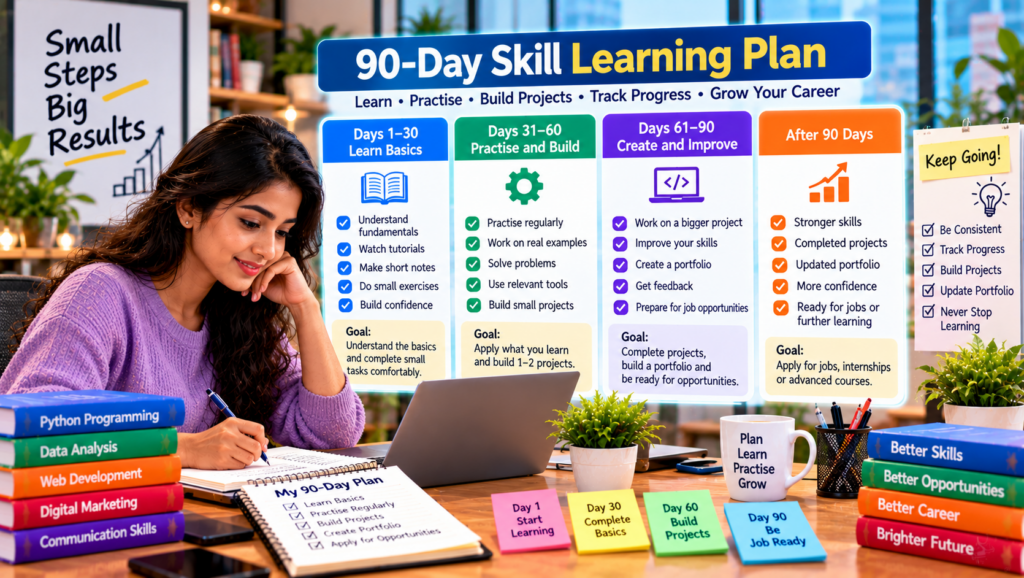
13. 90-Day Skill Plan: From Beginner to Job-Ready
If you are unsure where to start, follow this simple 90-day learning plan. Choose one skill that matches your career goal and practise consistently.
Days 1–30: Learn the Basics
- Understand the fundamentals of your chosen skill.
- Follow beginner-friendly lessons and tutorials.
- Practise for 30–60 minutes every day.
- Make short notes of important concepts.
Days 31–60: Practise with Real Examples
- Work on practical exercises and small tasks.
- Apply what you have learned to real-world situations.
- Identify your weak areas and improve them.
- Ask for feedback from teachers, mentors or experienced professionals.
Days 61–90: Build a Project and Prepare for Opportunities
- Complete one practical project related to your chosen skill.
- Prepare a portfolio or document your work.
- Update your resume with relevant skills and projects.
- Practise explaining your work during interviews.
Remember, learning a skill is only the first step. Regular practice and practical experience help you use that skill confidently.
Common Mistakes to Avoid When Learning New Skills
While learning new skills, avoid these common mistakes:
- Learning too many skills at once: Focus on one main skill before moving to another.
- Watching tutorials without practising: Apply your knowledge through exercises and projects.
- Choosing skills only because they are popular: Select skills that match your interests and career goals.
- Ignoring communication skills: Technical knowledge is valuable, but communication and teamwork are important too.
- Giving up too early: Consistent practice is more useful than studying intensively for only a few days.
Frequently Asked Questions (FAQs)
1. Which skills should I learn for jobs in 2026?
AI literacy, Advanced Excel, data analysis, digital marketing, cybersecurity, programming, communication and problem-solving are useful skills to explore. The right choice depends on your career goals.
2. Can I learn job-ready skills without a technical degree?
Yes. Many practical skills can be learned through courses, self-study and projects. However, some jobs require specific qualifications, certifications or degrees.
3. Which skill is best for beginners?
Advanced Excel, basic data analysis, AI tools and digital marketing can be starting points for many beginners. Choose according to your interests and the jobs you want to pursue.
4. How long does it take to learn a new skill?
You can learn the basics of some skills in a few weeks, but becoming proficient usually requires regular practice and practical experience. The time depends on the skill and your starting level.
5. Are AI skills important for future jobs?
AI literacy can help people understand and use AI tools effectively. It is useful to learn how AI can support your existing work while also checking the accuracy of its output.
6. How can I demonstrate my skills to employers?
Create practical projects, build a portfolio, document your achievements and include relevant examples in your resume. Be prepared to explain what you did and what you learned.
Final Thoughts: Start Learning Today
The job market continues to evolve as technology, business needs and workplace expectations change. Developing relevant skills can help you prepare for new opportunities and improve your confidence.
When choosing skills to learn for jobs in 2026, focus on your interests, educational background and career goals. You do not need to learn everything at once. Start with one useful skill, practise regularly and build projects that demonstrate your progress.
A small step taken today can help you move towards your long-term career goals.
Ready to Build Your Skills?
At Knowledge Hunt Computer Academy (KHCA), our goal is to help learners explore practical computer skills, technology and career development.
Explore our learning resources and courses to find a starting point that matches your interests.
Choose a skill. Start learning. Practise consistently. Build your future.
Start Learning with KHCA
Explore courses and build practical skills for your future.