
Choosing Commerce is an important step, but deciding what to do next can be confusing. After Class 12, students often think about B.Com, BBA, BCA, CA, CMA, CS or other courses. After graduation, new questions come up. Which job should I apply for? What skills do employers expect? What work will I actually do after joining a company?
Thank you for reading this post, don't forget to subscribe!These are common questions. Students should start looking for answers before completing their education.
A degree gives you subject knowledge, but most jobs also require practical skills, communication, computer knowledge and the ability to complete real tasks. For example, an accounts job may involve recording transactions and preparing reports. A banking role may involve customer requests, documents and financial products. A marketing job may require customer research, follow-up and campaign reporting.
The good news is that Commerce offers many career paths. You do not have to decide your entire future in one day. You can explore different fields, understand the work involved and build the skills needed for your preferred role.
In this guide, we will explore 10 important career paths for Commerce students in India in 2026. We will also discuss education options, job roles, practical skills, software tools, internships and ways to prepare for your first job.
Table of Contents
Why Should Commerce Students Start Career Planning Early?
Many students wait until their final year to think about employment. By that time, they may have a degree but little practical experience or knowledge of the jobs they want to apply for.
Starting early gives you time to explore different fields, learn relevant software, complete small projects and look for internships.
Consider two students studying B.Com. One focuses only on examinations. The other also learns Excel, practises accounting entries, prepares a sample financial report and builds a professional LinkedIn profile. Both students are studying the same degree, but the second student has more practical work to discuss during an interview.
This does not guarantee a job. However, it gives the student better examples to show their skills and a clearer understanding of the work involved.
A simple way to plan your career is to follow this sequence:
Education → Career Choice → Required Skills → Practical Projects → Internship or Experience → Job Applications → Continuous Learning

Best Career Paths for Commerce Students in 2026
Commerce offers many career opportunities for students after Class 12, B.Com, BBA, M.Com and other related courses. Students can choose a career in accounting and auditing, banking and financial services, finance and investment, taxation and GST, business management and operations, marketing, sales and digital marketing. Those who enjoy working with numbers and technology can explore data analytics and business intelligence using tools such as Excel, Power BI and SQL. Students interested in government jobs can prepare for competitive examinations according to their qualifications and eligibility. Commerce students can also explore law, corporate compliance and company secretarial work by choosing the required courses and professional qualifications. Another option is entrepreneurship and freelancing, where students can start a small business or provide services based on their skills. Each career path has different responsibilities, educational requirements and skill needs. Therefore, students should understand their interests, strengths and career goals before making a decision. Learning relevant software, developing communication skills, completing practical projects and gaining internship or work experience can help students prepare for these opportunities. In this guide, we will explore these career paths, the work involved, the skills students should learn and the practical steps they can take to prepare for their future.
1. Education Options After Class 12 Commerce
Before exploring specific jobs, understand the main education options available after Class 12. Each course has a different purpose, and the right choice depends on your interests, eligibility, budget and future plans.
B.Com — Bachelor of Commerce
B.Com is a degree option for students interested in accounting, finance, taxation, business and commerce-related subjects.
Depending on the university syllabus, students may study financial accounting, business law, economics, taxation, auditing, business statistics and financial management.
Possible career directions after B.Com:
- Accounts Assistant or Junior Accountant
- Accounts Executive
- Banking and financial services roles, subject to eligibility
- Taxation and GST support roles
- MIS or reporting roles after developing suitable computer skills
- Further study such as M.Com, MBA, CA, CMA or CS, subject to the relevant rules
What should you learn alongside B.Com?
Start with Excel, accounting fundamentals, professional email writing and relevant accounting software. Build practical projects instead of relying only on certificates.
BBA — Bachelor of Business Administration
BBA may suit students interested in business operations, management, marketing, sales, human resources and entrepreneurship.
The course generally introduces students to management, marketing, accounting, business communication and organisational behaviour. The exact subjects vary by institution.
Possible career directions after BBA:
- Business Development Executive
- Sales or Marketing Executive
- Operations Executive
- Customer Relationship Executive
- HR Assistant or Recruitment Coordinator
- MBA or other relevant postgraduate study
What should you learn alongside BBA?
Practise presentations, Excel, business communication, report writing and project planning. If you are interested in marketing, create sample campaigns. If you prefer operations, practise preparing schedules, budgets and progress reports.
BCA — Bachelor of Computer Applications
BCA is a computer-focused degree that may suit students interested in software, databases, IT services and technology-related business work.
Admission rules and subject requirements vary by university. Commerce students should check the official eligibility criteria before applying, especially the mathematics or computer-subject requirements where applicable.
Possible career directions after BCA:
- IT Support Executive
- Software or Application Support Trainee
- Junior Web Developer, with relevant technical skills
- Database or Reporting Support
- Further study such as MCA, where eligible
What should you learn alongside BCA?
Depending on your goal, learn programming fundamentals, databases, SQL, spreadsheets and problem-solving. Create small projects that demonstrate what you can build.
CA — Chartered Accountant
The Chartered Accountancy course is offered by the Institute of Chartered Accountants of India (ICAI). It is relevant to areas such as audit, taxation, accounting, financial reporting, risk and corporate finance.
Students need to understand the current registration route, examinations and practical training requirements before choosing this path.
Official information: https://www.icai.org/
CMA — Cost and Management Accountant
The Cost and Management Accountancy course is offered by the Institute of Cost Accountants of India (ICMAI). It focuses on cost accounting, management accounting, costing, budgeting and financial decision-making.
This path may suit students interested in understanding how businesses calculate costs, control expenses and plan their finances.
Official eligibility information: https://icmai.in/ClntStudents/CourseEligibility
CS — Company Secretary
The Company Secretary course is offered by the Institute of Company Secretaries of India (ICSI). It focuses on company law, corporate governance and compliance-related work.
This path may suit students interested in corporate documentation, company procedures, legal compliance and governance.
Official information: https://www.icsi.edu/
CA, CMA and CS have separate registration, examination, training and qualification requirements. Read the latest official rules before enrolling.
Other Options After Class 12
Depending on your interests and eligibility, you may also consider:
- Law courses, including integrated law degrees
- Economics or finance-related degrees
- Insurance and financial services training
- Banking and government recruitment examinations
- Digital marketing and business analytics courses
- Entrepreneurship and vocational skill programmes
Do not choose a course only because your friends are choosing it. Understand the subjects, cost, eligibility, duration and possible career directions before making a decision.

When exploring career paths for commerce students, compare the daily responsibilities, required qualifications and practical skills of each role before making a decision.
The best career paths for commerce students depend on their interests, strengths, qualifications and willingness to develop practical workplace skills.
2. Accounting and Auditing: Understand Business Transactions
Accounting is a common career path for Commerce students because businesses need accurate financial records. However, an accounting job involves much more than entering numbers into software.
What work does an accounts employee do?
Depending on the role and organisation, the work may include:
- Recording sales, purchases, receipts and payments
- Preparing and maintaining ledger accounts
- Checking invoices and supporting documents
- Reconciling bank statements with accounting records
- Tracking outstanding payments from customers
- Recording amounts payable to suppliers
- Assisting with GST records and tax-related documentation
- Preparing expense summaries and financial reports
- Supporting month-end closing activities
For example, an Accounts Assistant may receive a purchase invoice, check the details, record the transaction in the accounting system and file the supporting document. Another task may be comparing the bank statement with the company’s books and identifying differences.
Some tasks require supervision or approval from a qualified senior. Responsibilities differ between an Accounts Assistant, Accountant, Auditor and Chartered Accountant.
Which skills should you learn?
Accounting knowledge
- Journal entries and ledger posting
- Trial balance
- Profit and Loss Account
- Balance Sheet
- Bank reconciliation
- Basic taxation and GST concepts
Computer skills
- Excel formulas
- Sorting and filtering
- Lookup functions
- PivotTables
- Formatting financial reports
- Checking totals and identifying errors
Software
Learn TallyPrime or another accounting package used by employers in your target area. Software helps you record transactions, but you must also understand why a transaction is recorded in a particular way.
Workplace skills
Accuracy, attention to detail, confidentiality, organised record keeping and meeting deadlines are important.

How can you practise before applying for a job?
Create a sample business with imaginary transactions. Record sales, purchases, expenses and receipts. Prepare a bank reconciliation statement, a trial balance and a simple Profit and Loss Account.
Practise finding mistakes in a spreadsheet and checking whether the final figures match. Use only fictional or authorised training data. Never copy confidential financial records from an employer or client into a personal project.
3. Banking and Financial Services: Learn How Banking Operations Work
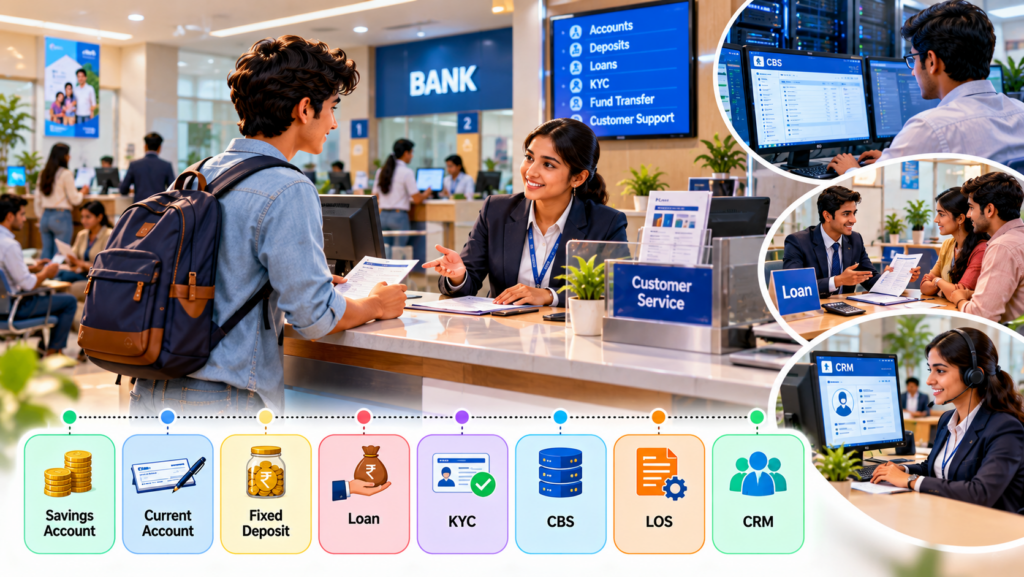
Banking includes more than accepting deposits or giving loans. Different teams handle customer service, account operations, payments, documentation, credit assessment, sales and compliance.
Students can explore public-sector bank recruitment examinations or suitable private-sector roles, apprenticeships and entry-level financial services jobs. Eligibility depends on the position and its recruitment notification.
What work may be involved in banking?
Depending on the role, a banking employee may:
- Help customers understand account services
- Support account-opening procedures and document checks
- Explain savings accounts, current accounts and fixed deposits
- Handle customer requests through approved systems
- Assist with payment or transaction-related queries
- Support loan application documentation
- Update customer records according to bank procedures
- Follow KYC, data protection and compliance requirements
- Refer complex cases to the appropriate team
For example, an employee handling account-opening support may check whether the required documents are present, verify information according to the bank’s procedure and send the application for the next stage. A loan-processing employee may organise documents and update the application status. Approval decisions may be handled by authorised officers or specialised teams.
Understand common banking terms
Savings Account: An account generally used by individuals to keep money and carry out everyday banking transactions.
Current Account: Commonly used by businesses and organisations that need to make frequent transactions.
Fixed Deposit: A deposit kept for a specified period under agreed terms and interest conditions.
Loan: Money provided by a lender under agreed repayment terms. The application may involve document checks, credit assessment and approval.
KYC — Know Your Customer: Procedures used to verify customer identity and other required information.
CBS — Core Banking System: A system that helps a bank manage customer accounts and banking transactions across its network.
LOS — Loan Origination System: Where used, it supports parts of the loan application and processing journey.
CRM — Customer Relationship Management: A system that may help teams maintain customer information and track service requests or sales activities.
The software and procedures differ across banks. Students should learn these concepts through authorised training materials and fictional examples, not by attempting transactions on real customer accounts.
Which skills are useful?
- Basic banking and financial product knowledge
- Numerical ability and attention to detail
- Customer communication and service
- Computer literacy and accurate data entry
- Document verification and record management
- Understanding of privacy and compliance
- Reasoning and exam preparation for relevant recruitment tests
For recruitment examinations, read the latest official notification on the relevant bank or IBPS website. Do not rely on old eligibility details or unofficial job advertisements.
Official banking recruitment resource: https://www.ibps.in/
When exploring career paths for commerce students, compare the daily responsibilities, required qualifications and practical skills of each role before making a decision.
4. Finance and Investment: Understand Money and Business Performance
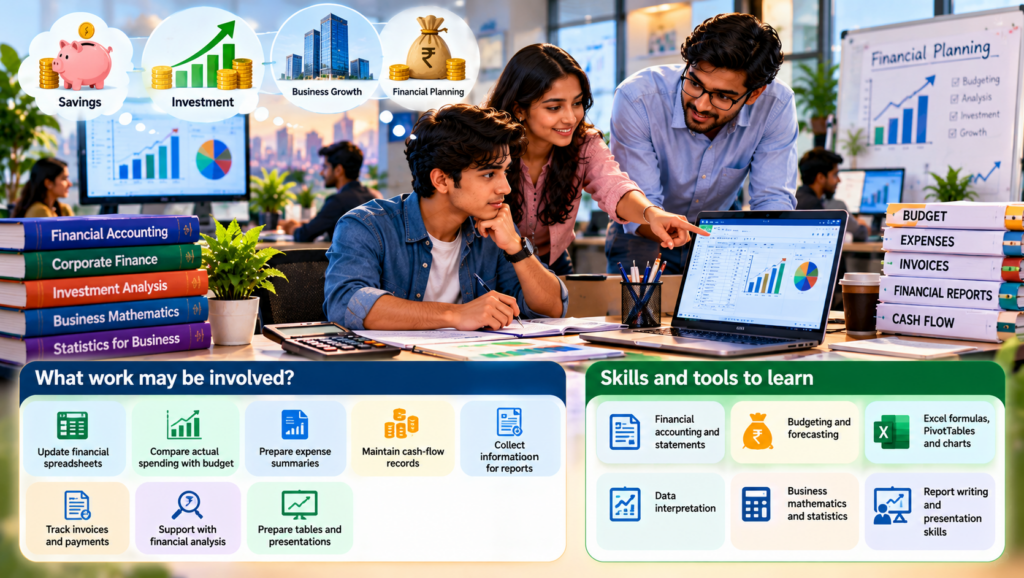
Finance roles involve managing budgets, tracking expenses, analysing financial information and supporting business decisions. Investment-related roles may require additional knowledge, qualifications or regulatory approvals.
What work may be involved?
A junior finance employee may:
- Update financial spreadsheets
- Compare actual spending with the budget
- Prepare expense summaries
- Help maintain cash-flow records
- Collect information for financial reports
- Track invoices and payment schedules
- Support senior staff with financial analysis
- Prepare basic tables and presentations for meetings
For example, a finance team may have a monthly budget for travel, marketing or office expenses. A junior employee may update the expense sheet, compare actual spending with the approved budget and report the difference to a senior.
The exact work depends on the company and job title. A Finance Assistant does not necessarily perform the same tasks as a Financial Analyst or Investment Professional.
Skills and tools to learn
- Financial accounting and basic financial statements
- Budgeting and forecasting
- Excel formulas, PivotTables and charts
- Data interpretation
- Business mathematics and basic statistics
- Clear report writing and presentation skills
Students can create a monthly budget, compare planned and actual expenses, and explain the differences. Another useful project is to analyse a sample company’s published financial statements.
Remember that financial advisory and investment services may be subject to specific rules. A short course alone does not automatically qualify someone to provide regulated financial advice.
5. Taxation, GST and Compliance: Understand Rules and Records
Taxation work requires accurate records, attention to detail and an understanding of applicable rules. Businesses need to maintain invoices, organise purchase and sales records, prepare information for returns and keep supporting documents.
What work may be involved?
A junior employee may:
- Organise sales and purchase invoices
- Maintain expense and transaction records
- Calculate tax amounts in training examples
- Reconcile figures across reports
- Collect documents required by a senior professional
- Assist with GST-related records and compliance work
- Check whether documents and transaction details are complete
For example, a trainee may organise purchase invoices by date, check invoice totals and prepare a spreadsheet summary. A senior professional may then review the records and handle the tasks that require additional authority or qualifications.
The authority to prepare, review or certify specific filings depends on the relevant rules and the person’s qualifications. A short course does not automatically allow someone to independently handle every tax-related task.
Skills and tools to learn
- Basic accounting and taxation
- GST concepts and invoice structure
- Excel for checking and summarising records
- Accounting software
- Document management
- Knowledge of current official filing requirements
Practise using fictional business transactions. Check whether totals match, documents are complete and records are organised.
Tax rules can change, so refer to official sources such as the GST portal and the Income Tax Department when learning current requirements.
- GST Portal: https://www.gst.gov.in/
- Income Tax Department: https://www.incometax.gov.in/
6. Business, Management and Operations: Learn to Get Work Done
Management and operations roles help an organisation coordinate people, information, schedules and everyday activities. Some companies recruit fresh graduates for trainee, coordinator or executive positions.
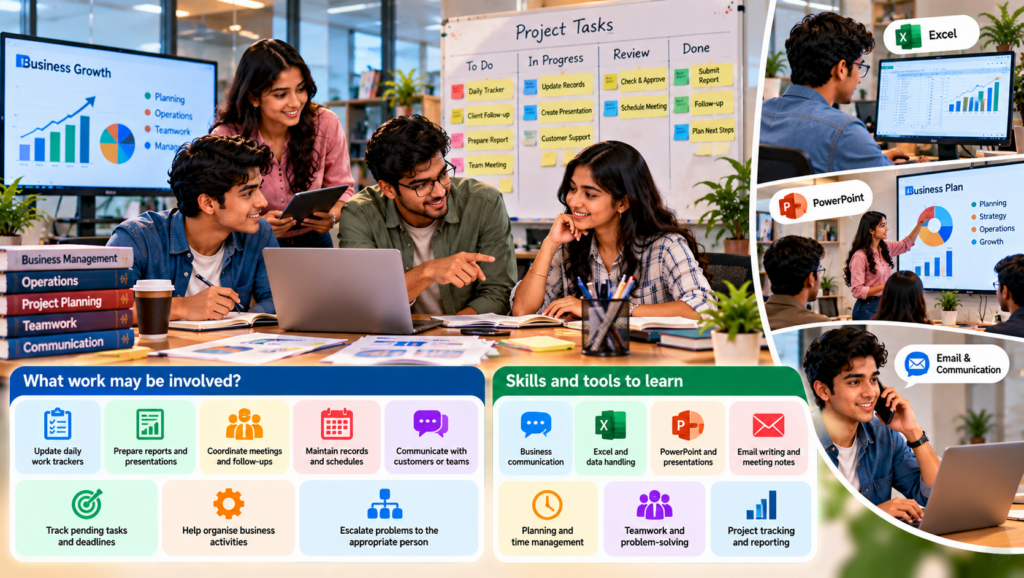
What work may be involved?
A junior operations or management employee may:
- Update daily work trackers
- Prepare reports and presentations
- Coordinate meetings and follow-ups
- Maintain records and schedules
- Communicate with customers or internal teams
- Track pending tasks and deadlines
- Help organise business activities
- Escalate problems to the appropriate person
For example, an Operations Executive may maintain a spreadsheet showing which tasks are complete, which are delayed and who is responsible for the next step. A coordinator may contact team members, update the schedule and prepare a progress report.
When exploring career paths for commerce students, compare the daily responsibilities, required qualifications and practical skills of each role before making a decision.
Skills and tools to learn
- Business communication
- Excel and PowerPoint
- Email writing and meeting notes
- Planning and time management
- Teamwork and problem-solving
- Basic project tracking and reporting
A useful project is to plan a college event or small business activity. Prepare a budget, timeline, task list and final report. This helps you explain how you organised work and handled problems.
BBA or MBA may support some career paths, but a degree alone does not guarantee a management position. Employers may also look for internships, communication, analytical ability and practical experience.
7. Marketing, Sales and Digital Marketing: Understand Customers
Marketing helps businesses understand customers, communicate the value of a product or service and reach the right audience. Sales and marketing are connected, but they are not exactly the same.
Sales often involves speaking with potential customers, understanding their needs and following up on opportunities. Marketing may involve customer research, content, campaigns, brand communication and performance analysis.
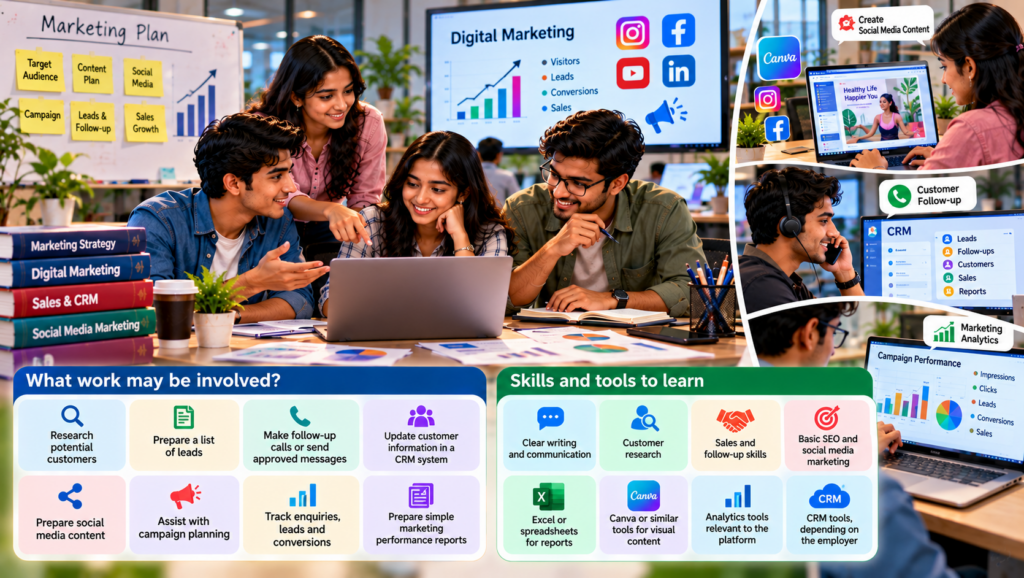
What work may be involved?
A junior marketing or sales employee may:
- Research potential customers
- Prepare a list of leads
- Make follow-up calls or send approved messages
- Update customer information in a CRM system, where used
- Prepare social media content
- Assist with campaign planning
- Track enquiries, leads and conversions
- Prepare simple marketing performance reports
For example, a Sales Executive may contact a potential customer, explain a product and record the response. A Digital Marketing Assistant may schedule content, check campaign results and prepare a report showing reach, clicks or enquiries.
Skills and tools to learn
- Clear writing and communication
- Customer research
- Sales and follow-up skills
- Basic SEO and social media marketing
- Excel or spreadsheets for reports
- Canva or similar tools for basic visual content
- Analytics tools relevant to the platform
- CRM tools, depending on the employer
Do not focus only on posting on social media. Learn to identify the target audience, set a clear objective, plan content and measure results.
For a practical project, select a local business and create a sample campaign plan. Include the target customer, content ideas, posting schedule, budget assumptions and the measures you would use to review performance.
8. Data Analytics and Business Intelligence: Turn Information into Useful Reports
Businesses collect information about sales, customers, expenses and performance. Data analytics helps them understand this information and make better decisions.
Commerce students may already have some experience working with numbers, but professional data roles require practice with tools, logical thinking and data interpretation.
What work may be involved?
A reporting or junior analytics employee may:
- Collect data from approved files or systems
- Check and clean data
- Prepare daily, weekly or monthly reports
- Compare sales, expenses or other performance measures
- Create charts and dashboards
- Explain trends and unusual changes
- Help teams answer business questions
For example, a reporting employee may compare sales across different months, identify products with lower sales and prepare a chart for a manager. The employee must also check whether the data is complete and accurate before sharing the report.

Skills and tools to learn
Excel: Formulas, sorting, filtering, lookup functions, PivotTables and charts.
Power BI: Data modelling, visualisation and dashboard creation.
SQL: Retrieving and summarising data from databases.
Statistics: Averages, percentages, variation and basic relationships between variables.
Communication: Explaining what the numbers mean, not just displaying a chart.
Build a practical project
Create or download a suitable sample sales dataset. Clean the data, calculate total sales and profit, compare monthly results and identify the best-performing products.
Then create an Excel report or Power BI dashboard. Write a short explanation of what you found and what questions the business should investigate next.
This project can be included in your portfolio and discussed during an interview. Do not present sample data as real company experience.
9. Government Jobs and Competitive Examinations: Prepare with a Clear Target
Some students prefer public-sector work or government recruitment examinations. Commerce education may be useful for certain roles, but eligibility is determined by each examination’s official notification.
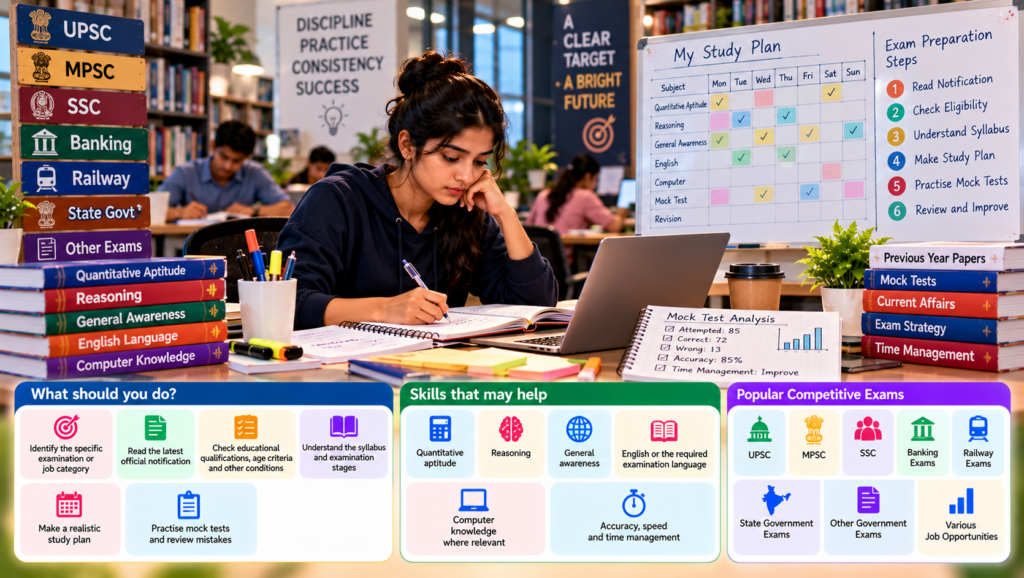
What should you do?
- Identify the specific examination or job category.
- Read the latest official notification.
- Check educational qualifications, age criteria and other conditions.
- Understand the syllabus and examination stages.
- Make a realistic study plan.
- Practise mock tests and review mistakes.
Depending on the recruitment rules, students may explore banking examinations, Staff Selection Commission examinations, state-level recruitment, civil services and other public-sector opportunities.
Do not assume that all government jobs accept the same qualification. Some posts require graduation, while others have different educational requirements.
Skills that may help
- Quantitative aptitude
- Reasoning
- General awareness
- English or the required examination language
- Computer knowledge where relevant
- Accuracy, speed and time management
Use official recruitment notifications rather than relying on social media posts or old information.
10. Law, Corporate Compliance and Company Secretarial Work
Commerce students interested in company rules, legal documents, governance and compliance may explore this area. It includes professional pathways as well as support roles, but the qualifications required vary.
The Company Secretary course is offered by the Institute of Company Secretaries of India (ICSI). Students interested in law can also investigate recognised law degrees and the relevant entry requirements.
What work may be involved?
Depending on the role and qualifications, work may include:
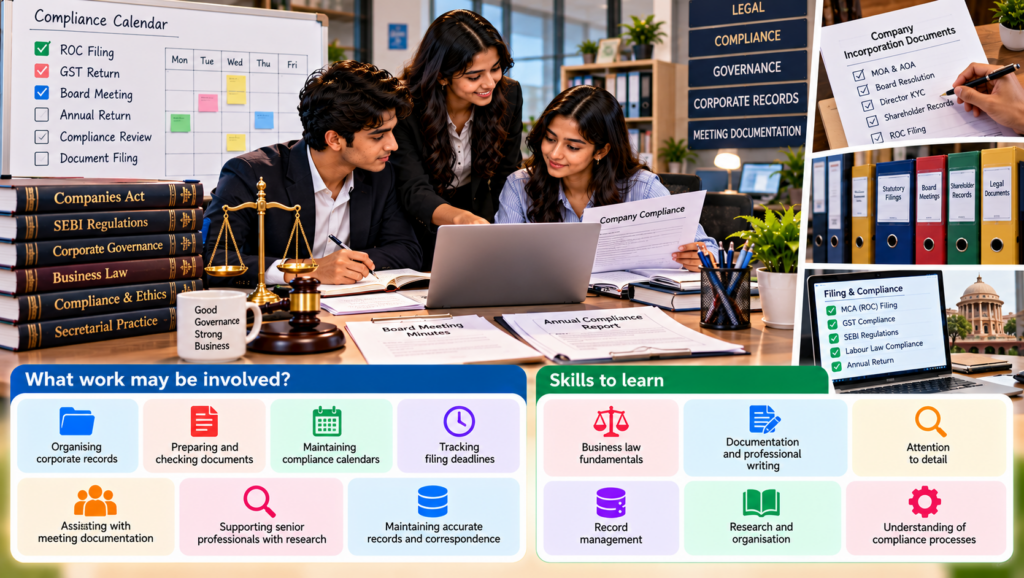
- Organising corporate records
- Preparing and checking documents
- Maintaining compliance calendars
- Tracking filing deadlines
- Assisting with meeting documentation
- Supporting senior professionals with research
- Maintaining accurate records and correspondence
For example, a compliance assistant may organise company documents and maintain a calendar of important deadlines. A qualified professional may be responsible for reviewing or approving specific compliance work.
Skills to learn
- Business law fundamentals
- Documentation and professional writing
- Attention to detail
- Record management
- Research and organisation
- Understanding of compliance processes
Before choosing a course, check the current rules of the relevant professional body or university.
11. Entrepreneurship and Freelancing: Build Your Own Opportunity
Some students want to start a business, provide independent services or sell products online. Commerce knowledge can help them understand costs, pricing, revenue, expenses and cash flow.
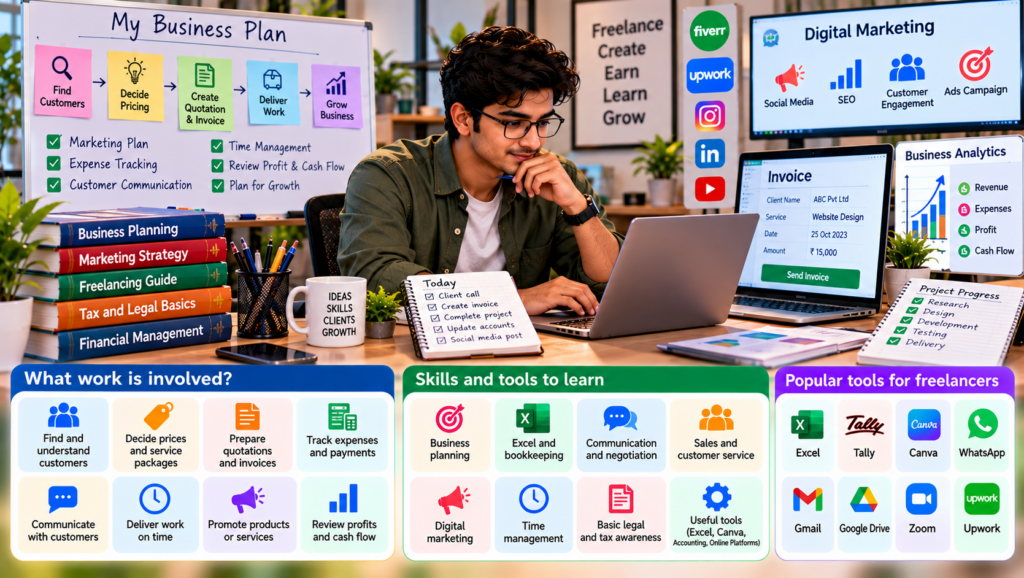
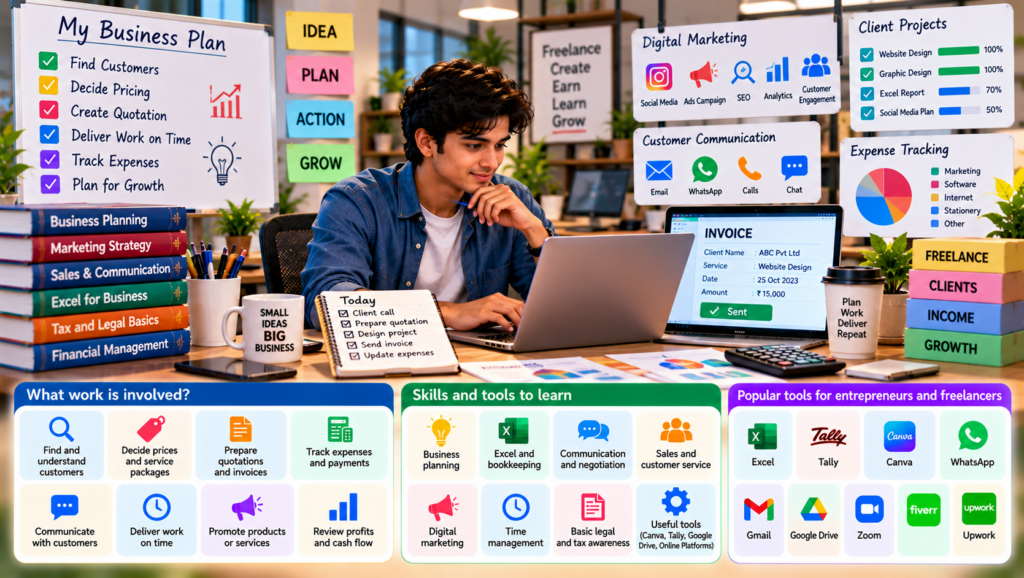
What work is involved?
A small business owner or freelancer may need to:
- Find and understand customers
- Decide prices and service packages
- Prepare quotations and invoices
- Track expenses and payments
- Communicate with customers
- Deliver work on time
- Promote products or services
- Review profits and cash flow
Skills and tools to learn
- Business planning
- Excel and bookkeeping
- Communication and negotiation
- Sales and customer service
- Digital marketing
- Time management
- Basic legal and tax awareness
Start small. Prepare a basic business plan, calculate expected costs and test whether customers are interested before making a large investment. Do not promise services that require qualifications or licences you do not have.
What Skills Should You Learn During College?
You do not need to master every tool or skill. Start with the basics and add skills based on the career path you want to follow.
Skills useful in many careers
Excel: Learn formulas, sorting, filtering, lookup functions, PivotTables and charts.
Communication: Practise speaking clearly, writing emails and explaining your work.
Professional writing: Learn to prepare reports, meeting notes and clear business messages.
Digital confidence: Understand file management, document preparation, presentations, online research and safe data handling.
Problem-solving: Practise identifying a problem, checking the facts and explaining your solution.
Teamwork: Learn to share responsibilities, meet deadlines and communicate progress.
Responsible AI use: Use AI tools to support learning and drafting, but verify facts, protect confidential information and understand the work you submit.
How to Prepare for an Internship
An internship is an opportunity to understand real workplace expectations. It is not only a certificate to add to your resume.
Before applying, read the job description and identify the skills the organisation expects. Prepare a basic resume and examples of your work.
During the internship:
- Ask questions when instructions are unclear.
- Take notes and maintain a task list.
- Learn the software used by the team.
- Check your work before submitting it.
- Respect confidentiality and data security.
- Communicate delays or problems early.
- Request feedback and act on it.
- Record what you learned and which tasks you completed.
For example, an accounting intern may organise invoices or assist with spreadsheet updates under supervision. A marketing intern may prepare content drafts or update campaign reports. A reporting intern may clean an approved dataset and prepare charts.
Your tasks will depend on the employer. Do not claim that you performed work you did not actually do.
Create Your LinkedIn Profile While You Are Still Studying
Do not wait until graduation to create your professional profile. A LinkedIn profile can help you present your education, skills, projects and career interests.
What should your profile include?
- A clear and professional profile photo
- A headline that describes your field or career interest
- Your education and relevant courses
- Skills you can genuinely demonstrate
- Academic projects and practical work
- Internship or volunteering experience, if applicable
- A short About section describing your interests and goals
For example, a B.Com student interested in accounting might use this headline:
B.Com Student | Learning Accounting, Excel and TallyPrime | Interested in Accounts and Taxation
Only list skills you have actually started learning or can demonstrate. Update your profile when you complete a project or gain new experience.
Connect respectfully with classmates, teachers, alumni and professionals in fields you want to explore. Read job descriptions and look at the skills employers mention repeatedly.
LinkedIn’s student resource is available at https://students.linkedin.com/
Build Projects That Show What You Can Do
A certificate shows that you completed a course. A practical project gives you an opportunity to demonstrate how you use what you learned.
| Career interest | Practical project |
|---|---|
| Accounting | Record sample business transactions and prepare a Profit and Loss Account |
| Banking | Create a fictional customer-service workflow and a checklist for account documentation |
| Finance | Prepare a monthly budget and compare planned versus actual expenses |
| Taxation | Create sample invoices and organise fictional purchase and sales records |
| Marketing | Develop a sample campaign plan for a local business |
| Data analytics | Analyse sample sales data and create an Excel report or Power BI dashboard |
| Management | Plan a college event with a budget, schedule and task tracker |
| Entrepreneurship | Prepare a basic business plan with pricing, costs and expected revenue |
Use fictional or authorised datasets. Keep your files organised and write a short explanation of the purpose, tools, steps and results of each project.
Prepare Your Resume and Interview Answers
A resume should be clear, honest and relevant to the job. It does not need to include every course you have ever attended.
Include your education, relevant skills, projects, internship experience and achievements that support the role you want.
When describing a project, explain:
- What was the task or problem?
- Which tools did you use?
- What steps did you follow?
- What did you learn or produce?
Prepare answers to questions such as:
- Tell me about yourself.
- Why are you interested in this role?
- What do you know about the work involved?
- Which software or tools have you practised?
- Tell me about a project you completed.
- How would you handle a mistake or an unclear instruction?
Do not claim expert-level knowledge when you are a beginner. Employers may ask you to demonstrate the skill you mention.
A Simple 90-Day Job Preparation Plan
If you are unsure where to begin, use this plan as a starting point. Adjust it to your college timetable and chosen career.
Days 1–30: Choose and Learn
- Select one career path to explore.
- Read job descriptions for relevant entry-level roles.
- Identify common skills and tools.
- Start learning the most important basics.
- Create or update your LinkedIn profile.
Days 31–60: Practise and Build
- Complete one practical project.
- Save your work in an organised portfolio.
- Prepare a first version of your resume.
- Practise explaining your project in simple language.
- Ask a teacher, mentor or knowledgeable person for feedback.
Days 61–90: Prepare and Apply
- Improve your resume and LinkedIn profile.
- Practise common interview questions.
- Search for suitable internships and entry-level openings.
- Apply only where you meet the relevant requirements.
- Track applications and follow up professionally.
- Continue improving the skills employers request.
This plan does not guarantee a job in 90 days. Its purpose is to help you move from uncertainty to a practical preparation routine.
How Can KHCA Help Commerce Students?
Knowledge Hunt Computer Academy (KHCA) focuses on practical computer education. Depending on your career goal, relevant learning areas may include:
- Tally and GST for accounting and taxation practice
- Advanced Excel for accounting, reporting and data analysis
- Power BI for dashboards and business reporting
- Office applications for everyday professional work
- Digital tools for presentations, communication and business tasks
Choose a course based on the work you want to do, not simply because a tool is popular. For example, a student interested in accounts may begin with accounting fundamentals, Excel and TallyPrime. A student interested in reporting may focus on Excel first, then explore Power BI and SQL.
Training can help you practise, but employment also depends on your qualifications, experience, communication, performance and the employer’s requirements.
Frequently Asked Questions
1. What can I do after Class 12 Commerce?
You can explore degree courses such as B.Com, BBA or BCA where eligible, professional courses such as CA, CMA and CS, law courses, vocational training or competitive examinations. Compare the subjects, cost, eligibility and career directions before choosing.
2. Is B.Com enough to get a job?
B.Com can meet the educational requirement for some entry-level jobs, but employers may also expect practical skills, communication and relevant software knowledge. Check the requirements of each role and build projects that demonstrate your abilities.
3. Which skills should a Commerce student learn first?
Excel, professional communication, email writing and basic computer skills are useful starting points. After that, choose tools according to your career path, such as TallyPrime for accounting or Power BI and SQL for analytics.
4. Can Commerce students enter data analytics?
Yes, students with a Commerce background can prepare for suitable analytics roles by learning Excel, basic statistics, data interpretation and relevant technical tools. Requirements differ across employers and positions.
5. Is an internship necessary?
An internship can provide practical experience and help you understand workplace expectations. It is not the only way to gain experience: projects, volunteering and relevant part-time work may also help. Choose opportunities that provide genuine learning and appropriate supervision.
6. Should I create a LinkedIn profile while studying?
Yes, you can create a profile while studying and update it with genuine skills, projects, education and experience. A profile does not guarantee a job, but it can help you present your professional interests and work.
7. How do I know which career path is right for me?
Start by identifying the subjects and activities you enjoy. Compare job descriptions, speak to people working in those fields and try small projects. Check the required qualifications before committing to a course or career route.
Conclusion
Conclusion
Commerce offers many career opportunities in accounting, banking, finance, taxation, business management, marketing, data analytics, government jobs, corporate compliance and entrepreneurship. The right career paths for commerce students depend on their interests, skills, qualifications and future goals.
Before choosing a career, understand the actual work involved and the skills employers expect. Do not depend only on your degree or collect certificates without practical experience. Learn relevant software, improve your communication skills, complete practical projects and prepare a professional resume. Internships, volunteering and suitable part-time work can also help you understand workplace expectations.
Start with one clear career goal and take small, practical steps towards it. Keep improving your knowledge and stay open to learning new skills as industries and job requirements change.
Your degree gives you a foundation. Your practical skills, experience and willingness to keep learning help you prepare for the world of work.
For practical computer training, explore the relevant programmes offered by Knowledge Hunt Computer Academy (KHCA).
Useful Official Resources
- National Career Service: https://www.ncs.gov.in/
- ICAI — Chartered Accountancy: https://www.icai.org/
- ICMAI — CMA Course Eligibility: https://icmai.in/ClntStudents/CourseEligibility
- ICSI — Company Secretary: https://www.icsi.edu/
- IBPS — Banking Recruitment Information: https://www.ibps.in/
- LinkedIn for Students: https://students.linkedin.com/
- GST Portal: https://www.gst.gov.in/
- Income Tax Department: https://www.incometax.gov.in/